Best Toys for Pugs That Get Bored Easily
Puzzle toys, chews, and gentle play ideas that keep your pug's mind happy.
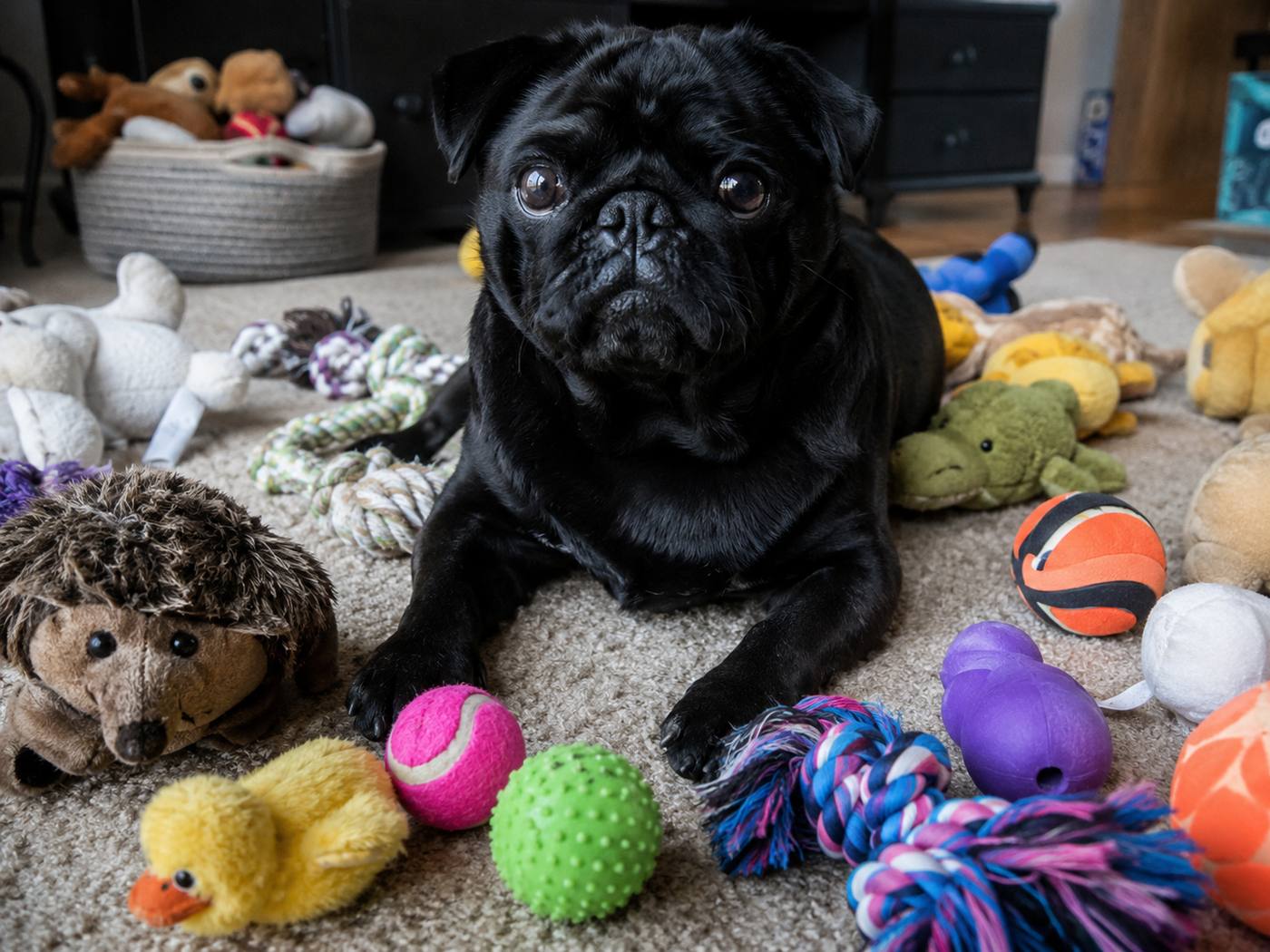
Pugs have a funny relationship with toys. They'll ignore a perfectly good chew toy for a week, then go absolutely wild over a crinkly paper bag for forty minutes. They're not lazy — they just have opinions.
If your pug seems restless, is getting into things it shouldn't, or just stares at you with that particular look of mild dissatisfaction, it's worth thinking about whether it has the right kind of stimulation. And for pugs specifically, "the right kind" matters more than it does for some other breeds.
Here's why — and what actually helps.
Why Pugs Need Mental Stimulation (Maybe More Than Exercise)
Pugs are a brachycephalic breed, which means their flat faces come with narrowed airways. They tire quickly during physical activity and can overheat faster than longer-snouted dogs. A 20-minute walk might be plenty. A long game of fetch in warm weather is a bad idea.
That's not an excuse to do nothing with them — boredom is a real problem that shows up as destructive chewing, attention-seeking, restlessness, and sometimes anxiety. But it does mean the toys that work best for pugs are often the ones that engage their mind rather than demanding a lot of sustained physical effort.
Puzzle toys, snuffle mats, chew toys, and short bursts of interactive play tend to suit pugs much better than toys designed for high-energy dogs who need to run.
What to Look for in a Pug Toy
Before getting into specific categories, a few things are worth keeping in mind when buying any toy for a pug:
Size: Pugs have small-to-medium mouths. Toys that are too large are useless to them, and toys that are too small are a choking hazard. Look for toys labelled for small or medium breeds. If a toy has pieces that could easily fit entirely in your pug's mouth, it's too small.
Durability: Pugs aren't usually aggressive power chewers, but some are surprisingly determined. Check whether a toy is holding up after the first few sessions — anything falling apart quickly means your pug could swallow pieces.
No intense exertion required: Avoid toys that encourage your pug to sprint, jump repeatedly, or play hard for long stretches. A short burst is fine. Extended intense play is not — especially in warm weather or for pugs with known breathing issues.
Easy to clean: Pugs are drool-prone and put toys through a lot of mouth contact. Toys you can wash regularly are worth the slight extra investment.
The Best Types of Toys for Pugs
Puzzle Feeders and Slow Feeder Toys
These are probably the single most useful category for pugs, for two reasons. First, they provide genuine mental engagement — a pug working out how to get kibble or treats out of a puzzle is a pug that is thinking, which tires them out in a satisfying, healthy way. Second, they slow down eating, which matters for pugs because they have a tendency to eat too fast and, over time, to gain weight.
Puzzle feeders come in a wide range of difficulty levels. For a new pug or an older dog, start simple — a rubber toy with a hollow centre that you can stuff with food, or a basic sliding tile puzzle. More advanced puzzles with multiple steps can work well for younger pugs who figure out the easy ones quickly.
One honest note: some pugs will give up on a puzzle if it's too hard or if they're not food-motivated enough. You'll know your pug. Use high-value treats if the kibble isn't cutting it.
Snuffle Mats
A snuffle mat is a mat with lots of fabric strips or pockets where you hide small pieces of food. The dog has to use its nose to find them. It sounds low-tech, and it is — but most pugs absolutely love this.
Sniffing is mentally tiring in the best way. Even a short snuffle session (five to ten minutes) can settle a restless pug down. These are also particularly good for older pugs or those with more pronounced breathing issues, because they don't need to move around much to engage with them.
You can also make a basic version at home using a rubber mat and fleece strips if you want to try the concept before buying one.
Chew Toys
Chewing is natural and satisfying for dogs. For pugs, the right chew toy can keep them occupied for a good stretch of time without any physical exertion at all.
Look for rubber chew toys of an appropriate size — firm enough to last, but not so hard that they risk cracking teeth. A good general rule is that if you wouldn't want to be hit hard with the toy, it's probably too hard for a dog's teeth. Very hard nylon or plastic chews carry a tooth fracture risk, which is worth knowing.
Avoid anything with small parts that could break off and be swallowed. Check the toy regularly for damage, and replace it when pieces start coming off.
A note on rope toys: Many dogs love rope toys, and pugs often do too. The concern is that when rope toys start to fray, the fibres can be swallowed and cause digestive blockages. They're fine to use with supervision, but probably not the best choice for a toy your pug plays with unsupervised.
Squeaky Toys (Soft and Sized Appropriately)
A lot of pugs are very motivated by squeaky toys. The sound triggers something and they engage with them enthusiastically, which is good. The thing to watch is whether your pug tends to try to extract the squeaker — some do, and if they manage it, the squeaker itself becomes a choking or blockage hazard.
Soft squeaky toys designed for small breeds are generally fine, especially for supervised play. Just check them regularly and retire any that are starting to come apart.
Short Interactive Play Toys
Toys you can use with your pug for short play sessions — a soft tug rope, a short wand toy, something you can move around for them to chase — can be great for bonding and mental engagement. Keep sessions brief, watch for panting and slow down before they get overheated, and always let your pug set the pace. If they're losing interest or breathing heavily, it's time to stop.
Pugs are not built for long games of fetch. But a few minutes of light tug or chase-the-toy can genuinely make them happy, and it's good for your relationship with them too.
Toys to Avoid (or Use Carefully)
Very hard chews (like hard antlers or dense nylon bones) — risk of tooth fractures
Toys with small detachable parts — choking hazard
Fraying rope toys used unsupervised — fibre ingestion risk
High-energy fetch toys if you're encouraging long sessions — pugs overheat quickly
Anything requiring sustained vigorous running — not appropriate for brachycephalic dogs, especially in warm weather or for pugs with diagnosed breathing issues
How Many Toys Does a Pug Need?
More isn't necessarily better. A pug with twenty toys often ignores all of them. Rotating toys — keeping some out and swapping them every week or two — tends to keep pugs more interested than leaving everything out permanently. The "new" toy after a week in storage gets more attention than the one that's been sitting on the floor for a month.
A reasonable starting collection might be: one or two puzzle feeders or a snuffle mat, one durable chew toy, one or two soft squeaky toys, and something interactive for play sessions with you. That's enough to cover different kinds of engagement without overwhelming your space or your pug.
A Quick Word on Boredom vs. Anxiety
If your pug seems consistently unhappy, destructive, or is barking or whining a lot, it's worth considering whether what you're seeing is simple boredom or something closer to separation anxiety. The two can look similar, but they're different problems with different solutions. Toys can help with boredom but won't fully address anxiety.
If you've tried enrichment toys and your pug is still distressed, especially when left alone, it's worth speaking to your vet. There are effective, practical approaches to separation anxiety — but they usually go beyond just adding more toys.
FAQ
My pug ignores most of its toys. What should I do?
Try rotating toys — put most away and bring out one or two at a time. After a week in storage, a toy feels "new" again. Also try adding a small amount of food or treat paste inside or near the toy to build initial interest. High-value treats work better than kibble for reluctant pugs.
Are Kong-style toys good for pugs?
Yes, stuffed rubber Kongs are one of the best options for pugs. They provide mental stimulation without physical exertion, can be frozen to last longer, and are durable enough for most pugs. Use a size appropriate for small breeds and stuff with pug-safe foods like plain pumpkin purée, banana, or a little peanut butter (xylitol-free only).
How long should I let my pug play with toys?
Short sessions work best — five to fifteen minutes at a time for interactive play. Puzzle toys and chew toys can be left longer since they don't require physical exertion. Watch for heavy panting or overheating and stop play immediately if either occurs.
My pug destroys every toy. What's the most durable option?
Look for tough rubber toys designed for moderate chewers, such as natural rubber chew toys sized for small breeds. Avoid very hard nylon or antler chews, which can crack teeth. Check toys regularly and replace them when pieces start coming off.
Are puzzle toys safe if my pug eats too fast?
Yes — puzzle feeders are actually one of the best solutions for fast eaters. They slow the eating process naturally and reduce the air gulping that causes gas and vomiting. Choose puzzles with wide, shallow channels to suit a pug's flat face.
At what age can I give a pug puppy toys?
From the moment they come home. Soft, appropriately sized puppy toys are safe from 8 weeks. Avoid anything with small detachable parts, hard materials, or anything that requires sustained physical effort. Supervise play until you know how your puppy interacts with each toy type.
Related Articles
Can Pugs Be Left Alone? Separation Anxiety Guide
How long can a pug be left alone, signs of separation anxiety, and practical steps to help your pug feel calm when you're out.
Read more →
Is a Pug Right for You? Honest Guide for Future Owners
Thinking about getting a pug? Read the honest pros, cons, health needs, lifestyle fit, and real ownership costs before you commit.
Read more →Are Pugs Easy to Train? Beginner Training Guide
Pugs can be stubborn, but they are trainable. Learn what actually works, how short sessions should be, and the biggest mistakes to avoid.
Read more →